Thursday, June 15, 2017

Thinking "Worldviewishly"

The term "worldviewishly" was coined by John Stonestreet and Brett Kunkle in new their book "A Practical Guide to Culture: Helping the Next Generation Navigate Today's World".  This book is a required reading assignment for all HCA staff this summer and provides some provocative challenges and practical help for teachers and parents.

In the fourth chapter, "The Information Age", the authors address the importance of a worldview, noting that "we don't look at our worldview; we look through it.  The question isn't whether we have a worldview.  The question is what worldview has us."  They note that today, like never before, we (and our students) are being bombarded with information from a variety of sources, and it is critical we join the Apostle Paul in praying:
It is my prayer that your love may abound more and more, with knowledge and all discernment, so that you may approve what is excellent, and so be pure and blameless for the day of Christ, filled with the fruit of righteousness that comes through Jesus Christ, to the glory and praise of God (Phil 1:9-11)
If we (and our students) are going to effectively engage our culture, we need to be prepared to engage the ideas presented by our culture with our "baloney detectors" ( Nancy Pearcey, "Total Truth: Liberating Christianity From Its Cultural Captivity") on full power.  As Stonestreet and Kunkle note, "if we can't master ideas, ideas will master us.  If we passively absorb the information around us, some else is thinking for us."

I particularly loved the disclaimer they suggested we remember as we engage the culture around us:
"The following (song, movie, program, commercial, speech, tweet, post, image, story, book, sermon, etc.) contains ideas in the form of arguments (my editorial comment:  more accurately 'assertions'), embodied characters, narrative consequences, satirical exaggerations, and/or emotional outbursts.  These ideas will be assumed to be true, though not necessarily supported by arguments, and reflect the worldview of the actors, producers, directors, musicians, writers, or speakers.  Discretion is advised."
 So what of the practical suggestions?  How do we build up our discernment, our "baloney detectors"?  The authors suggest:
  1. Talk about worldview early and often.  Our students/children need to know that every song, movie, television program, article, speech, tweet, post, and commercial reflect values rooted in a worldview.
  2. Explain non-Christian worldviews.  When ideas are named, they are far less intimidating and powerful.  Kids need the ability to identify worldviews when the encounter them.
  3. Strongly encourage your kids to read good books.
  4. Discuss ideas whenever possible.  Opportunities to talk about worldviews are everywhere - song lyrics, news topics, commercial messages, movies, etc.  These are all venues where our culture expresses its worldview.
  5. Teach them to ask good questions.  What do you mean by that?  How do you know it is true?  What if you're wrong?  And be prepared for them to throw those questions back to you from time to time!
Heritage Christian Academy is committed to partnering with Christian parents in this critical task.  Our mission statement places "development of a Biblical worldview" in a central focus.  May God give us grace as we work together to develop "bold champions for truth" prepared to effectively engage their own culture.


Wednesday, May 17, 2017

The Crown of the Aged

Grandchildren are the crown of the aged ...
Proverbs 17:6

Over the years (even before I became one of the "aged") I often referred to this verse when talking with grandparents at our annual Grandparents' Day.  Why does Solomon say that grandchildren are the crown of the aged?  Why not children?  It has to be more than the joy that comes from spoiling our grandchildren (with impunity) like we never could our own children.

As I have reflected on this, I believe the answer lies here:  When a parent sees that his children are raising godly children, he knows his children have truly "made their faith their own."  He sees that Psalm 78 is taking place:
" ... that the next generation may know them, the children yet unborn, and arise and tell them to their children, so that they should set their hope in God and not forget the works of God, but keep his commandments ..." (vv 6-7)
Every time I am around my grandchildren (5 with #6 on the way), I am grateful for the faithfulness of their parents in raising a godly generation.  I truly feel "crowned."  And in a similar fashion I am grateful for former students who are faithfully following God, ministering to their own generation.  We literally have graduates all over the world faithfully serving their families, their churches, and their communities with Christ's love.

Allow me to share with you some blogs from former students I follow as representatives of the alumni of HCA (and BCS and WCA before it) who are faithfully serving God in the world.

Jordan (Huston) Carlson - Class of 2006
In this post, Jordan talks about John the Baptist's testimony that his joy was found in his own personal decrease in the light of Christ's increase.  Jordan's testimony is this:

So it is for all of the people of God. Just as John the Baptist spent his life in the service of Christ, being sent ahead to prepare the way, so we are to spend our lives in joyful service to God, rejoicing as Christ takes center stage.

John Piper states it this way: “God calls us to pray and think and dream and plan and work not to be made much of, but to make much of him in every part of our lives.
//resplendentsoul.wordpress.com/2016/09/15/he-must-increase/

Ruth Anne Burrell - Class of 2009
In her blog Ruthie, sharing how she is a fan of the BBC Sherlock Holmes mystery series, notes the following dialogue:

After Mary Watson throws herself in front of a bullet to save Sherlock, the often arrogant and flippant detective is lost—confronted by a type of sacrificial love he didn’t know existed.
“In saving my life, she conferred a value on it,” he says. “It is a currency I do not know how to spend.”
It’s not often that a line of TV dialogue catches my attention for its beauty. This one made me pause my video and skipped back to re-watch it.
In saving my life, she conferred a value on it.
It is a currency I do not know how to spend.
I mulled over the quote for a few days, trying to figure out why it struck me so, and what I came up with was this:
In saving my life, Jesus conferred a value on it. And that is a currency that I often do not know how to spend.
http://www.ruthanneburrell.com/?p=1298

Kaleigh (Adkins) Stickles - Class of 2011
Together with a couple of friends from college, Kaleigh formed a ministry called BeYOUtiful in Christ.  Their mission is stated in part:  We proclaim that our identity comes from Him and Him alone.  Our desire is to teach girls to place their faith in Jesus and embrace themselves for how fearfully and wonderfully God has created them."

In this blog post, Kaleigh references the current Netflix series 13 Reasons Why which chronicles the thirteen reasons a teenager took her own life.  In response, Kaleigh lists 13 reasons why life is worth living.  She says:
I cried during most of the episodes. I didn’t necessarily cry because of the horrible things done to Hannah Baker.  I cried because I will walk the school hallways.  Not as a student, but as a teacher.  I now play a vital role in a LIFE. How many Lord?  How many young lives do I pass by, bump into, and say hello to are struggling? How many need ONE person to pour Jesus into their life?  How many do we ALL pass daily?

http://bicflawless.wixsite.com/wearebic/single-post/2017/04/23/13-Reasons-Why-Life-is-Worth-Living

Join me in thanking God for the alumni of HCA and praying for their continued influence for Jesus Christ around the globe.

Thursday, March 30, 2017

Do As I Do

"Your walk talks, and your talk talks ... but your walk talks louder than your talk talks."

"What you do speaks so loudly I can't hear what you say." - Ralph Waldo Emerson

Several years ago (OK, many years ago) when my son was in late elementary/early JrHi, I was talking with a friend of mine at church when my son was trying to get my attention.  I was ignoring him, continuing what was surely a life-changing conversation with my friend.  Eventually, however, he got my attention, and I responded with exasperation, "Matthew, be patient!!"  My friend just smiled, turned to my son, and said, "Yeah, Matthew ... just like your dad."

I was reminded of this exchange recently when I read an article addressing how parents should teach their children to make good decisions.  The author suggested that these are really life-long "conversations" we are having with our children, prefaced with the words "Watch how I <fill in the blank>."
Our campus pastor told us he sat his tween son down to explain the birds and the bees but prefaced it with this, “We are going to begin a conversation that we will be having the rest of your life. This is not a one-time conversation. This is the start of many conversations.” Whew!

Are you able to say, “Watch how I have a healthy marriage. Watch how I keep my eyes from lust. Watch how I honor my spouse. Watch how I protect my marriage”?

What about technology? Can you say, “Watch how I unplug regularly. Watch how I rule technology and don’t let it rule me. Watch how small it is in my life”?

What areas of your life can you say “Watch how I do this”? Which ones do you not want your kids to see? Gossip? Fear? Focus on outward appearance? Work ethic?

It reminds me of what the apostle Paul told the Corinthian church, “Follow my example, as I follow the example of Christ” (1 Corinthians 11:1). It’s not about being fake-perfect or play-acting what should be done. It’s not about being a Pharisee and making up your own standards and rules.
Can I really make Paul’s same statement? I have to follow Christ. Not put on a show for my kids. Follow Christ. Then, I can glance back and say, “Come on! Jump in! I’m a few steps, a few years, ahead in my walk with Jesus. Follow me as I keep my eyes on Him! Watch me!”
At HCA we talk a lot about the partnership we have with parents in the process of bringing up our children "in the discipline and admonition of the Lord."  As I reflect on that, I am struck anew with the importance of living our lives in such as way that we can humbly say "Watch how I <fill in the blank>."

"Yeah, Matthew ... Just like your dad!!"

Tuesday, February 21, 2017

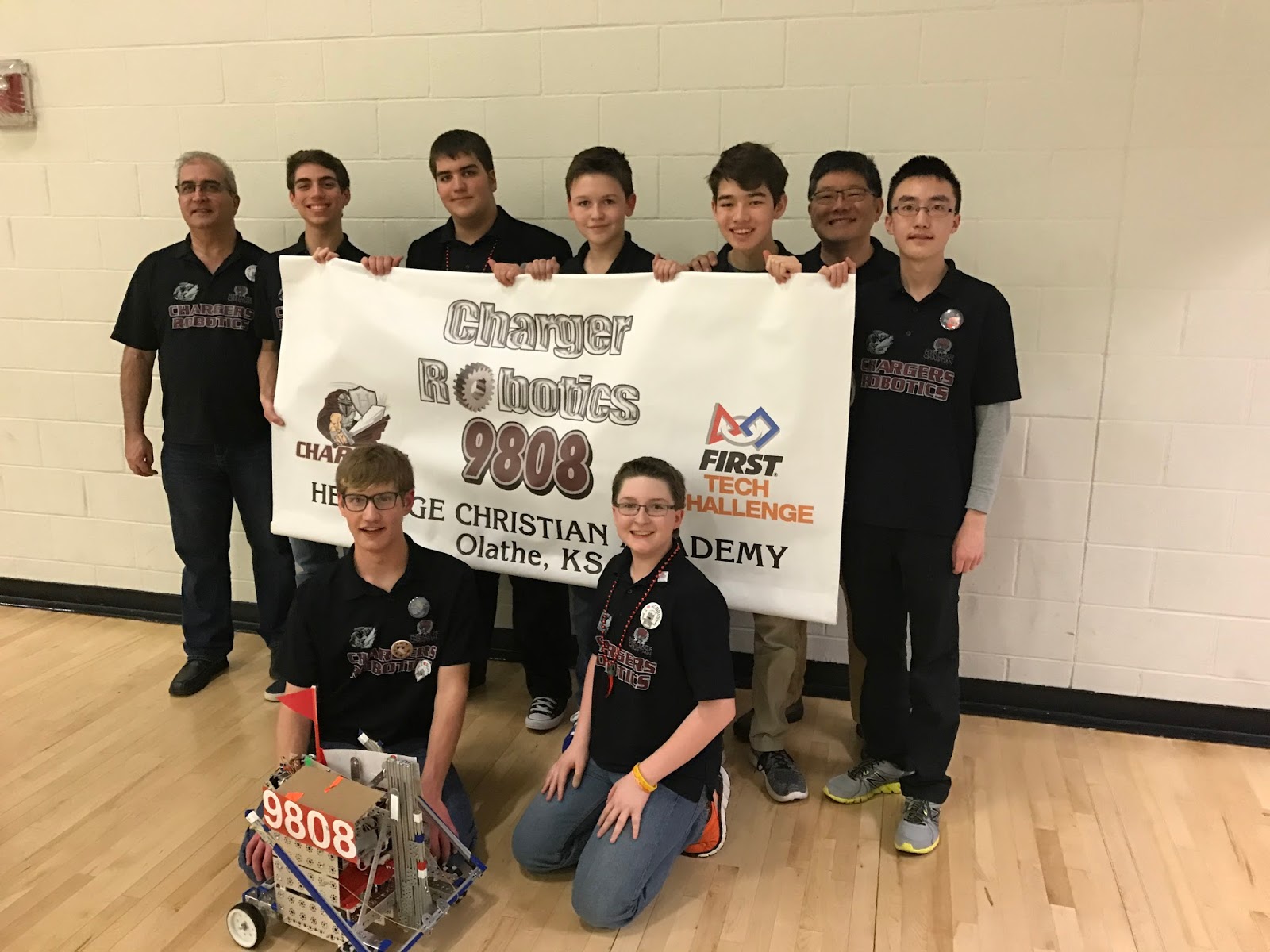
Charger Robotics Team Advances to State Championship Tournament

“Team Chargers” (FTC Robotics team #9808) joined 22 other teams at the Missouri FTC Western Conference Qualifier at Harrisonville High School on Saturday, February 18th, six of whom would advance to the Missouri State Championship. Team Chargers earned a spot in this Conference Qualifier by finishing second overall in the NW Conference, winning 8 of 10 matches during the conference season.

Team Chargers swept through the preliminary matches of this Conference Qualifier Tournament undefeated with a 4-0-1 record, finishing with a 3rd place ranking and earning a position as an alliance captain for the elimination round.  During alliance selection, Team Chargers accepted an invitation to join the top ranked Red Hot Techie Peppers - team #4587 and Ravonics Spitzer - team #9801(from Olathe NW HS) for the elimination matches.    Our alliance won the semifinals round, 2 matches to 1, with Team Chargers strongly contributing to both winning matches.  Team Chargers then capped the day with a win in the finals to be crowned tournament champions. 

In addition to being a part of the winning alliance, Team Chargers were recognized by the judges for the following awards:

Inspire Award (1st Place) - The description of this award reads: This judged award is given to the team that truly embodied the ‘challenge’ of the FTC program. The team that receives this award is a strong ambassador for FIRST programs and a role model FTC team. This team is a top contender for many other judged awards and is a gracious competitor. The Inspire Award Winner is an inspiration to other teams, acting with Gracious ProfessionalismTM both on and off the playing field. This team is able to communicate their experiences, enthusiasm and knowledge to other teams, sponsors, their community, and the Judges. Working as a unit, this team will have demonstrated success in accomplishing the task of designing and building a robot.  The judges remarks about Team Chargers: “This team’s first year did not go as planned, and they realized dealing with stress is part of moving forward.  Following a mentor presentation on getting organized, they were really charged up.  After only two seasons, they are building a heritage.”

Contact Award (1st Place)
- The description of this award reads:  Mastering robot intelligence. The Control Award celebrates a team that uses sensors and software to enhance the robot’s functionality on the field. This award is given to the team that demonstrates innovative thinking in the control system to solve game challenges such as autonomous operation, enhancing mechanical systems with intelligent control, or using sensors to achieve better results on the field. The control component should work consistently on the field. The team’s Engineering Notebook must contain details about the implementation of the software, sensors, and mechanical control. In presenting this award, the judges commented: “This team in black took control with a strong autonomous performance.  Their use of sensors was impressive.  Their planning served as a catalyst for an organized strategy consistent with the team’s heritage of taking charge.”

Motivate Award (2nd Place) - The description of this award reads: This judged award celebrates the team that exemplifies the essence of the FIRST Tech Challenge competition through team building, team spirit and exhibited enthusiasm. This team embraces the culture of FIRST and clearly demonstrates what it means to be a team. This is a team who makes a collective effort to make FIRST known throughout their school and community, and sparks others to embrace the culture of FIRST.

Prior to advancing to the West Missouri Conference Qualifier, Team Chargers competed in two “NW Missouri conference” tournaments and one “FTC qualifying” tournament, held at Blue Valley CAPS.    Among their accomplishments along the way:
  • Team Chargers finished second among all teams competing in the 8 NW Missouri conference tournaments, winning 16 out of a possible 20 points in the two meets HCA played in.  (8 out of 10 matches played)
  • The Chargers were awarded 3rd Place for the PTC “Design Award” at the Blue Valley CAPS qualifier tournament.
  • Team Chargers was chosen to be in one of four alliances for the elimination round semifinals at the Blue Valley CAPS qualifier.
  • In all of the 702 total matches played in Missouri FTC this season, Team Chargers competed in matches recording the highest scoring match score (335) and also the 5th highest match score for the entire season.
  • Team Chargers with our alliance partners had the 6th highest (205) and 8th highest (200) alliance scores for the entire Missouri FTC season.
Team Chargers (FTC team #9808) will join 47 other teams at the Missouri FTC State Championship at Missouri S&T in Rolla, Missouri on Saturday, March 4th with the opportunity to advance to the FTC SuperRegional in April.  This tournament will feature the “best of the best”, and Team Chargers will have to be at the top of its game to advance to the Super Regional multi-state tournament.  Winners from the Super Regional advance to the National Championship Tournament.

#Ready4TheRobotRumbleInRolla 


Wednesday, January 25, 2017

Make America Great Again

Disclaimer - THIS IS NOT A POLITICAL POST!!

Regardless of your political persuasion, you cannot possibly have navigated the last two years in the US without at some point coming in contact with the phrase "Make America Great Again."  Mercifully, the election is over.   However, I think former First Lady Barbara Bush got it right when she famously said "our success as a nation... depends not on what happens inside the White House, but on what happens inside your house. ”

I can't help but be reminded of the observations of Alexis de Toqueville, a French diplomat who visited the United States early in the 19th century and published a work called Democracy in America, an effort to help the French people have a better understanding of the emerging democracy on this side of the Atlantic Ocean.  In this publication, de Toqueville identified the source of the greatness of America:
"In the United States, the sovereign authority is religious...there is no country in the world where the Christian religion retains a greater influence over the souls of men than in America, and there can be no greater proof of its utility and of its conformity to human nature than that its influence is powerfully felt over the most enlightened and free nation of the earth.  In the United States, the influence of religion is not confined to the manners, but it extends to the intelligence of the people...Christianity, therefore, reigns without obstacle, by universal consent...
I sought for the key to the greatness and genius of America in her harbors...; in her fertile fields and boundless forests; in her rich mines and vast world commerce; in her public school system and institutions of learning. I sought for it in her democratic Congress and in her matchless Constitution. Not until I went into the churches of America and heard her pulpits flame with righteousness did I understand the secret of her genius and power. America is great because America is good, and if America ever ceases to be good, America will cease to be great."
By partnering with Christian families and evangelical churches, Heritage Christian Academy seeks to do its part to "make America great again."  As a part of our mission, we desire to develop the next generation of Christian leaders with a distinctly Biblical worldview.  It is those leaders who will lead godly homes and serve in churches that faithfully proclaim the Word of God with "pulpits flaming in righteousness."

Heritage Christian Academy ... Making America Great Again!!


Alexis de Toqueville

Thursday, November 17, 2016

Find your IKIGAI


DON'T BE LIKE THIS GUY!  In an episode of Seinfeld, the infamous "show about nothing", the following exchange took place:

Kramer: You’re wasting your life.
George : I am not. What you call wasting, I call living. I’m living my life.
Kramer: OK, like what? No, tell me. Do you have a job?
George : No.
Kramer: You got money?
George : No.
Kramer: Do you have a woman?
George : No.
Kramer: Do you have any prospects?
George : No.
Kramer: You got anything on the horizon?
George : Uh, no.
Kramer: Do you have any conceivable reason for even getting up in the morning?
George : I like to get the Daily News.

A recent study in my small group Bible study posed the same same question "Why do you get up in the morning?"  Once I got past the shallow "Because my phone alarm went off" or "I like getting a pay check" responses, I realized this simple question is in many ways a profound one.  This question, often asked in job interviews, is asking about life purpose and motivation.  In a previous blog post, I argued that "passion" is really a question of what you are willing to die for; this question is asking what you are living for?

The Japanese language actually has a word for this phrase - IKIGAI.  It is really a compound word in Japanese - "living" and "worth", i.e. a life worth living.  As a mulled over this question,  I began to ask "What is my IKIGAI?  Why am I going to get up tomorrow morning?"

This train of thought led me to the book of Philippians where Paul clearly identifies his IKIGAI.  It quickly becomes clear that Paul's IKIGAI is bound up in his relationship with Christ.  Passages say that his imprisonment is for Christ (1:13), he wants to live a life worthy of the gospel of Christ (1:27), he counts all thing loss for the sake of Christ (3:7), he strives to know Christ (3:10), he is pressing toward the goal of the prize of the upward call of God in Christ (3:14).  But the clearest statement Paul makes of his IKIGAI, his reason for waking up in the morning, is found in the famous declaration in 1:21 - For to me to live is Christ!!

For Paul - by extension for every Christian - his IKIGAI was clear.  Every day is an opportunity to live our lives for the sake of Jesus Christ.  Romans 8:29 tells us we were saved to be conformed to the image of his Son. Ephesians 2:10 calls us God's masterpiece created for good works that he has ordained.  That is my IKIGAI - an opportunity to partner with God in conforming me into image of his son and serving him with those works he has ordained for me to do.

By God's grace, we hope to instill this same IKIGAI in a generation of students at HCA - students who understand their position in Christ and will become leaders in their world, living each day for the glory of Jesus Christ.

What reason do you have to get up tomorrow morning?


Friday, September 9, 2016

Balance and the Truth

"Balance is an offense to the truth."  That was the closing line of column written by a political science professor at Gettysburg College.  She was explaining her inability to provide a balanced discourse in her classroom during the current presidential campaign because, in her view, one of the candidates was so disqualified as to warrant a balanced presentation.  She concluded by saying: "My approach for the fall semester will be boldly honest: It is a disservice to students to attempt to provide balance when I know that balance is an offense to the truth."

My initial reaction to that statement was negative - a typical "tolerant" liberal expressing intolerance toward someone or some idea she doesn't agree with.  But I quickly realized that I didn't really disagree with that statement; I simply disagree with her misapplication of it.  In fact, I wholeheartedly agree that "balance is an offense to the truth."

The problem lies in an understanding of "truth."  In this case, I believe the professor was confusing a truth claim with a preference claim.  She made a strong and passionate case why she preferred one candidate over the other; she clearly views the possibility that this candidate could become President as loathsome.  But no matter how strong her opinions or how passionately she holds them, they still fall short of being a truth claim.  In fact, I would be surprised if this professor philosophically even holds to the existence of something called objective truth; in the post-modern world truth is a personal construct, something that differs from person to person.  For a post-modern, it is simply intellectually dishonest to suggest that anything is "the truth."

At HCA we strive to help our students discern the difference between truth claims and preference claims.  But to do that, you must first believe that objective truth exists.  For the Christian, that truth is found in the written Word (Jn 17:17 - "Your Word is truth.") and the Living Word (Jn 14:6 - "I am the way, the truth, and the life.")  It is in that context that I agree ... balance is an offense to the truth.  We don't present a "balanced" view of salvation; salvation is by grace through faith apart from meritorious works. (Eph 2:8-9)  And "there is no other name under heaven ... by which we must be saved."  (Acts 4:12)  It would be an offense to the truth to balance that message by saying there are multiple ways to be saved.  We don't present a "balanced" view of Scripture ... it is the inspired, inerrant, authoritative Word of God.  We don't balance that message by suggesting that there are other sources of authoritative truth.

In fact, the Five Solas of the Reformation affirm that "balance is an offense to the truth."
  • Sola Scriptura - Scripture alone
  • Sola Fide - Faith alone
  • Sola Gratia - Grace alone
  • Solus Christus - Christ alone
  • Soli Deo Gloria - To the glory of God alone
May God "guide us into all the truth" (Jn 16:13) and may we reject "balance" that is an offense to that truth.


Wednesday, May 11, 2016

What Is Your Passion?


"The word 'passion' has been hijacked ... Misused and abused ... Emasculated by a feel-good culture of moral relativism ... Prostituted by personal development gurus.  Passion today is understood as 'what excites you, what puts the sparkle in your eyes, the twinkle in your toes.'  The word has become candy for frivolous children when, at its roots, it is meat for dedicated adults."

A few weeks ago as I was preparing to speak in our high school chapel on Biblical compassion, I came across a web posting that began with the words above.  In my presentation on "compassion", I noted that the word itself means "to suffer with" and denotes more than a feeling of sympathy; rather it carries with it a call to action.  Multiple times throughout the gospel accounts we see Jesus was "moved to compassion" closely followed by the action he took to relieve the suffering he saw.  We concluded that Biblical compassion mirrors Christ's example - it is a call to action.

Although there is scant evidence that the author of this website, Stephen Palmer,  identifies as a follower of Christ (in fact some elements elsewhere in his website would argue otherwise), he references Christ frequently and correctly notes that the word "passion" itself was likely coined in the 12th century by religious scholars to describe the sufferings of Christ on the cross. He describes Christ's passion as the "cross-carrying, torture-enduring suffering of a Man who understood how and why to sacrifice immediate pleasure for long-term joy."  He is so close to the truth - if he only understood that "joy" as described in Hebrews 12:1-2 is the joy of presenting his Bride before his Father.

Building on the "suffering" roots of the word passion he defines passion by quoting author Kevin Hall: “Even though it has become popular to define passion as deep or romantic love, the real meaning is being willing to suffer for what you love. When we discover what we are willing to pay a price for, we discover our life’s mission and purpose.”

Palmer concludes: If passion is simply what makes you happy, you’ll quit doing it when it gets tough, when it becomes too risky, when you’re ignored and mocked. Your true passion is -
  • what you’re willing to do if it kills you.
  • what you stick with even when it’s excruciating, when it’s risky.
  • the things you do because you know they’re right; because you know they’ll make a profound difference.
  • the things that simmer in the deepest parts of your soul — far beyond what’s fun or what feels good.
What is your passion?  What are you willing to suffer for?

Thursday, April 14, 2016

The Parent Rap

https://www.rightnow.org/Content/illustration/102049

Link 

Vimeo


Love is Patient

Think Christian link

Francis underscores a love that is not linked to others conforming to my wishes. “Patience takes root when I recognize that other people also have a right to live in this world, just as they are,” he writes. “It does not matter if they hold me back, if they unsettle my plans, or annoy me by the way they act or think, or if they are not everything I want them to be. Love always has an aspect of deep compassion that leads to accepting the other person as part of this world, even when he or she acts differently than I would like.” Perhaps this is why interpreters find it so hard to slot the Pope into our categories of thinking. We’re used to assuming that disagreement entails deep division and derision, whereas Francis is often both firm in his doctrinal stance and kind in his pastoral approach. In this, he may be a model for all Christians of how to follow our Savior down a path that both confounds and attracts.

Thursday, March 31, 2016

21st Century Skills

I recently came across an article from the World Economic Forum where they identified skills that are valued in the 21st century workforce. (Specific definitions of each of these 16 identified skills are listed in Appendix 1 in the linked article.)  The foundational literacies are the traditional core skills (reading, writing, and arithmetic) with an emphasis on application.  As our economy moves from an industrial production model toward an information technology model, the competencies become more and more important, eloquently articulated by Daniel Pink in his book A Whole New Mind.  But I was primarily interested in the character qualities, asking myself how we, as a Christian school, can help develop those skills.

My mind went to a recent activity I was closely involved with here at HCA.  Mr. Russ Miller and I worked with a group of students and adult mentors who joined with 40+ other teams from a 4-state area in the First Technology Challenge robotics competition in late January.  This competition was the culmination of a process that began in September when the details of this year's competition were announced.  For the next 4 months, a dozen students and 6-7 adult mentors worked to design and build a robot to accomplish the various tasks presented in this competition.  Curiosity was demonstrated as the team discussed various strategies to score the most points.  Students showed initiative by stepping up to the challenge and taking on various elements of the task.  Failure is always are part of the process like this - Edison famously said, "I didn't fail a thousand times to create a light bulb; I was successful in finding 1,000 ways that didn't work."  When faced with a concept that didn't perform as expected, the team was forced to show grit (see previous post) to keep pursuing the goal and adaptability in finding new ways to accomplish the task.  It was a delight to see different students step up a various times during the process to assert leadership, accepting the challenge of a specific part of the task.  And of course, the social dynamic of a group of this size working together for four months required a keen sense of social awareness.

This is only one example of the type of activity that helps students develop these skills.  I could write a similar paragraph on an athletic team, the senior class ministering together on their missions trip, or a group of students preparing for a dramatic production.  The key is that these are all elements of lifelong learning.  In fact, I think you could make the case that those items listed in the 2nd and 3rd columns become more important as life goes on.  And at the end of the day, we want our students to be lifelong learners.

NOTE:  For the record, the rookie Charger Robotics team performed well enough to be chosen to be one of a dozen teams to move on from the qualification rounds to compete in the elimination round.

Monday, March 7, 2016

TRUE GRIT

In the 1969 movie True Grit, Mattie, on a mission of "justice" to avenge her father's death, recruits an ornery, one-eyed federal marshal named Rooster Cogburn (John Wayne) because he has "true grit", a reputation for the ability to get the job done.  In the end (spoiler alert), they get their man with Mattie showing significant grit of her own.

I was recently reading a review of a book by Paul Stolz called Leadership GRIT: What New Research Reveals, a book that is now on my "wish list."  Stolz begins his book by defining leadership GRIT as "the capacity to get your team, or followers in general, to dig deep and do whatever it takes -- even sacrifice, struggle, and suffer -- to achieve their most worthy goals in the best ways."  I couldn't help but notice the similarity between this definition and the "grit" that Mattie was looking for in Rooster Cogburn.

Stolz identifies four dimensions of GRIT as follows:
  • Growth - The propensity to seek and consider new ideas, additional alternatives, different approaches, and fresh perspectives.
  • Resilience - The capacity to respond constructively to -- and ideally make good use of -- all kinds of adversity.
  • Instinct - The gut-level capacity to pursue the right goals in the right way.
  • Tenacity - The degree to which you persist, commit to, stick with, and relentlessly work at whatever you choose.

As I looked at this list, I couldn't help but notice that Christians should be uniquely qualified, in the power of the Holy Spirit, to demonstrate "true GRIT".  We are called to "grow in the grace and knowledge of our Lord Jesus Christ." (II Peter 3:18)  James calls us to "consider it all joy" when we are faced with adversity.  (James 1:2)  I recall one translation renders this "count trials as friends" because they are producing character in our lives.  The Christian replaces "gut-level capacity" with a reliance on the Holy Spirit and the Word of God to direct us to the right goals.  Oswald Chambers defines tenacity as "endurance with the absolute certainty that what we are looking for is going to transpire."  This is Biblical hope, defined by John Piper as "a confident expectation and desire for something good in the future" - referred to by the writer of Hebrews as "the full assurance of hope." (Hebrews 6:11) - the hope that motivated the Apostle Paul to say, "I have fought the good fight, I have finished the race, I have kept the faith."

May God give us grace to graduate students with "true grit"! 

NOTE:  See this article which specifically addresses the "resilience" and "tenacity" elements of GRIT.


Monday, February 8, 2016

STEM-ing the Tide

A year ago in a post entitled Where Are the Future Leaders, I referenced a Cardus Education Survey 2011 which pointed to the success of evangelical Christian schools in developing and nurturing the future leaders of our churches.  The 2014 version of the Cardus report, Private Schools for the Public Good,  confirms those findings while shedding some light on the state of advanced math and science as well as STEM education in private schools.

This report, drawn from a representative sample of 1,500 American high school graduates between the ages of 24 and 39 (1993-2008 high school graduates), compares evangelical protestant, catholic, and private non-religious schools with public schools in a variety of measures.  Not surprising are the findings that the private school cohort performs well in every measure when compared with their public school counterparts.  However, there are several measures where evangelical private schools fall short when compared with their private school counterparts, primarily in courses in the STEM (Science, Technology, Engineering, Math) sector:
  • Students are likely to take higher-level math and science courses
  • Students indicate interest in science and math after graduation
  • High school math classes increase students' interest in math
  • High school prepared students well for success in math or science courses in college or university
  • Advanced degrees earned (an area which showed improvement from the 2011 survey)
  • Professional or science occupation
  • Management or professional occupation
This report does not prescribe a course of action; its stated goal is to "uncover differences that may be instructive for improving all schools."  The data doesn't provide the "why", but in its analysis, the Cardus report suggests a couple of things that may be in play here.

First, in noting the tendency of evangelical protestant graduates to choose "human service careers" such as social work, health care, education or vocational Christian ministry, the authors suggest that these graduates "may not be be interested in professional, science, and management positions because they may view such work to less consistent with a religious calling."  If that is truly the case, then evangelicals are teaching a limited view of calling.  It is certainly commendable that Christian schools are successful in encouraging involvement in ministry related careers, but a call to a STEM related field is as much a "religious calling" as another other profession.  Martin Luther addressed this very topic several hundred years ago:
“The works of monks and priests, however holy and arduous they be, do not differ one whit in the sight of God from the works of the rustic laborer in the field or the woman going about her household tasks, but that all works are measured before God by faith alone.”
At HCA, we have developed an annual Winterim program where we take four days in January to specifically focus on the subject of calling.  We believe that the creation mandate to "subdue the earth" is a broadbased call for Christ-followers to be leaders in every part of the labor force.  Like Eric Liddell in Chariots of Fire, we want our students to "feel God's pleasure" when they are following his calling on their lives.

A second area of concerned raised by the authors of the Cardus Report, is the potential existence of a "structural reason" for a lack of opportunity for students in evangelical schools, including lack of sufficient funding and difficulty in attracting science teachers.  Again, HCA has addressed those concerns.  Two years ago we began to develop at path to a STEM diploma which included a new Introduction to STEM Topics, offering the PLTW course curriculum (the ONLY private school in the Kansas City area to do so), and involvement in extracurricular STEM activities such as the recently concluded FTC competition in Kansas City.  HCA has made a significant budgetary commitment toward this effort and we have benefited from the generous support of several individuals and corporations in this effort.  To support this initiative, HCA has been blessed to be able to assemble a formidable lineup of passionate, qualified science and math teachers.

By God's grace, HCA will continue to "STEM the tide".

Thursday, February 4, 2016

Team Charger Has Successful Rookie Season in FTC Competition

At Heritage Christian Academy we recently completed their first season competing in the FTC division of FIRST Robotics.  Our season began in September when the 2015-16 FTC game, iResQ, was announced nationally.  With that announcement, our team of 12 students in grades7-12 and 7 adult mentors began meeting weekly (and soon multiple times each week) to begin the process of designing and building our robot to compete in a qualifying tournament in early 2016.  Multiple prototypes were designed, tested, and ultimately discarded before settling on our final design in early December.  We spent the remaining weeks testing and refining this design before heading to our January 30th competition.

On January 30th we arrived early in the morning at UMKC with 44 other teams from Kansas, Missouri, Arkansas, and Oklahoma.  In the morning we had our robot inspected for compliance to rules, met with FTC judges, and collaborated with other teams with whom we would be allied in actual competition.  Shortly after noon, the qualifying matches began.  At the conclusion of those matches, the top four teams in each of two divisions were allowed to invite other teams to be in their alliance for the elimination rounds.  Team Charger was excited to be one of those teams selected, largely because we had demonstrated that we were one of 4-5 teams in the entire competition capable of securing the maximum number of points by handing our robot from the "mountain."

Unfortunately, our final alliance was eliminated from the competition, but the students left with their appetites whetted and ready to tackle a new challenge next year.


Thursday, December 10, 2015

Keeping Your Eye on the Horizon


Henry Ford famously said, "Obstacles are those frightful things you see when you take your eyes off your goal."

Joe Ehrmann, author of the bestselling book InsideOut Coaching, addressed the need for a purpose and a calling in telling coaches:

"Too many coaches have no clear, concise purpose other than winning and choose of path uncertain of where they will end or how their direction will affect their players.  You can't navigate a ship by studying the wind and the waves alone - you have to set your sights on a port, a lighthouse, some WHY - the purpose that keeps us centered and focused on honoring the high calling of being coaches."

Goal ... Purpose ... Calling .... Somehow those terms are intrinsically linked.  God has a goal for all believers - transformation into the likeness of Christ. (Romans 8:29, 2 Corinthians 3:18).  Our purpose in life, then, should be to understand and pursue that goal of Christlikeness, not through some legalistic list of do's and don'ts but by beholding the person of Christ as revealed in the Gospel.  As Jerry Bridges says in his book The Discipline of Grace, "to be like Jesus is not to just to stop committing a few obvious sins such as lying, cheating, gossiping, and thinking impure thoughts.  To be like Jesus is to always seek to do the will of the Father ... to come to the place where we delight to do the will of God ... simply because it is His will."

The path we take to this goal is unique for every person ... that is where our calling comes in.  Just as the body is made up of many parts, the Body of Christ is made up of unique individuals with unique gifts ... a unique calling.  The challenge is to understand our calling and how God wants to use that to lead us to our ultimate goal, Christ-likeness.

Winterim, a special event at HCA that will be taking place in early January, is intended to help our students understand and pursue their calling.  Students in grades 9-12 will attend a special set of courses for four days designed to allow them to explore topics outside the normal curriculum, taught by HCA staff as well as parents and other members of the larger community.  This gives Winterim instructors the opportunity to share an area of passion in a hands-on, interactive setting.  This initiative is part of a larger effort to encourage HCA students to recognize God’s call on their lives ... a call to use the gifts and talents he has given them to His glory ... by Him, to Him, for Him! 

Here's to keep our sights set on the Lighthouse!! 


Tuesday, November 10, 2015

Leadership Lessons from Blue October

My turn to write a entry for the school blog is upon me and, to be honest, I have been obsessed for the past month with Blue October, the mysterious malady that has infected all of Kansas City like nothing in the last 30 years.   The entire city, myself included, has been obsessed with the Royals run to a World Series title, concluding with a massive celebration where 800,000 people converged on downtown KC for the parade and pep rally.

So what to write about?  Since I have been thinking about Royals baseball 24/7, I decided to look at their epic run to a championship for leadership lessons.  As I have read countless articles, both in the local newspaper (yes, that still exists!) and online, I have encountered a number of recurring themes as skilled writers around the country have tried to capture the essence of this team. 

Leadership is vision - "Good leaders create a vision, articulate the vision, passionately own the vision, and relentlessly drive it to completion." (Jack Welch, retired CEO of General Electric)

When Dayton Moore arrived in Kansas City in 2006, he came with a vision for building a winning franchise from one that had been historically bad in recent years.  His vision included rebuilding the farm system (A few years later, it was rated the best farm system in baseball.), a commitment to the scouting department, especially in Latin America (The Royals have one of the strongest contingents of Latin American players in all of baseball.), and recruiting a stable of athletes suited in play in the confines of Kauffman Stadium (That athleticism was on full display in their recent World Series run.).

He relentlessly pursued that vision, again and again avoiding the temptation to sabotage his plan with short-term, expensive free agent signings.  He knows Kansas City cannot play that game.  Even in the euphoria of this postseason, he has remained resolutely committed to his vision.  

Leadership is teamwork - The Royals mantra "keep the line moving" went viral during this most recent postseason run.  There is no single intimidating individual in that lineup, no 40-HR guys ... but as the much-maligned Joe Buck noted in calling them the best team he has covered, "they can go one through nine in their lineup."  Alex Gordon is projected to earn $100 million dollars as a free agent this offseason - he batted eighth. They were six outs away from elimination against the Astros in the first series, but they "kept the line moving" to erase a 4-run deficit.  They were being dominated by David Price in the second game of the Blue Jay series before the got "the line moving" to complete another of their eight comeback wins.

Leadership is relentless - Josh Donaldson, Blue Jays All-Star third baseman said after one of the Royal's comeback wins, "These guys come to play all 27 outs ... They make you work for all of them."  This is probably the over-riding theme of this postseason ... the Royals set a postseason record for comebacks after the 7th inning.  The simply never gave up.  They continued their late-inning heroics in the World Series.  They had a homerun in the bottom of the 9th in Game 1 of the World Series to prolong the game before winning in extra innings.  They scored three runs in the eight of Game 4 to take a 3-1 series lead.  And they saved their best for last, scoring two runs in the top of the 9th of Game 5 to tie before winning the series with another extra inning victory.

As I look a these qualities, I can't help but think of Nehemiah and the children of Israel coming back to rebuild the city walls.  Nehemiah had a vision, a vision of the former glory of Jerusalem provided by God and passed on by the his ancestors.  The whole process of rebuilding the wall was an exercise in teamwork with different families assigned the part of the wall nearest their home.  And Nehemiah and the children of Israel were relentless in pursuing their vision, resisting efforts from the enemies around them to thwart their work.

Tuesday, October 6, 2015

#ForeverRoyal

We are entering Blue October, the Major League Baseball postseason in Kansas City.  Royals fans are familiar with the hashtag #ForeverRoyal ... the mantra of support for the recent resurgence of our team into national prominence.  For the Christian, however, #ForeverRoyal has an entirely different meaning.  

As a part of our "Culture of Kindness" initiative at HCA this year, I was recently asked to speak in chapel on a Biblical view of courtesy.  Beyond a simple definition (the showing of politeness in one's attitude and behavior toward others), I am always interested in the etymology of a word, i.e. where does the word itself come from.  It was a pretty simple matter to find that the word comes from Middle English from French from Latin and means "having manners fit for a royal court."  From that origin, it is clear the concept of "courtesy" could be summarized as "act like you are royalty."

Interestingly enough, the Bible tells us we are just that ... royalty.

  • "But you are a chosen people, a royal priesthood, a holy nation, a people belonging to God, that you may declare the praises of him who called you out of darkness into his wonderful light." -1 Peter 2:9
  • The Spirit Himself bears witness with our spirit that we are children of God, and if children, then heirs; heirs of God and joint heirs with Christ … Romans 8:16-17
  • "How great is the love the father has lavished on us, that we should be called children of God! And that is what we are!  1 John 3:1

In my continued study on this topic, I came across this article by Dr. Roy Alden Atwood.  Dr. Atwood refers to the same passages above to make the case that our children are indeed royalty, just as young Prince George, son of Prince William and Duchess Kate is royalty in great Britain.  And just as George's education is designed to prepare him for his role as royalty, the education of our children must be preparing them for the role as "heirs of the King."  As Dr. Atwood noted, "the House of Windsor pales in comparison to Jesus’s realm and our divine inheritance! How much more, then, should we, who are heirs of the King of kings and Lord of lords, prepare ourselves and our children to be thoroughly and faithfully educated in everything it means to be a son and daughter of the Creator, Redeemer, and Lord of the Universe. Thoroughly and faithfully educated in everything it means to be royalty."

Atwood continues by observing that "education, even that which purports to be Christian, is now often devoted primarily to the goal of producing good little workers for the secular labor force, efficient widgets for our economy’s production line, and little more.  That falls far short of the biblical expectation that Christian children be saturated in the instruction of the Lord and grow up knowing what it means to be royal heirs of Christ the King. An education bearing the name of the King ought, at the least, to offer His royal heirs . . ."

  • A comprehensive and integrative understanding of God’s world and of how all things cohere in the Lord Jesus Christ ... in other words, as worldview consistent with Biblical truth, giving "children the “big picture” of how all things, all spheres of creation, are interrelated in the glory of their Creator". (Eph 1:4-11)
  • Truly godly and wise teacher-mentors.  According to Jesus, the teacher—not the curriculum, not the lesson plan, not the technology, not the facilities, not the accreditation, not the tuition rate—is the single most important factor in a child’s education. (Luke 6:40)
  • The shaping of our desires for the things of the Kingdom. Christ did NOT say “Seek first vocational-technical training, and all that kingdom of God and righteousness stuff will be added later.” Rather, he instructs us to seek first the Kingdom of God. (Matthew 6:32-33)  
 I want to enthusiastically commend this article to you. I have only scratched the surface of the wealth of wisdom found there.  

You are the royal heirs of the King of kings; start acting like it.
Your children are royalty; start treating them like it.
Your children are inheriting a Kingdom; so start educating them for it.


Monday, August 31, 2015

Providing a Compass


Several years ago I was sitting in a theater watching Mr. Holland's Opus, an inspiring tale of a frustrated musician working to write his orchestral masterpiece, his opus, only to realize in the end that the students' lives he had touched over the years were truly his opus.  It remains one of my favorite "teacher movies."

However, right in the middle of this thoroughly secular movie came a statement with profound worldview implications.  Mr. Holland is talking with his principal, explaining that he is doing his job, arriving on time, and doing the best he can to teach his students.  His principal responds, "A teacher is two jobs. Fill young minds with knowledge, yes. But more important, give those minds a compass so that that knowledge doesn't go to waste."

I almost came out my chair.  I wanted to turn to the audience and exclaim, "Did you hear what she just said?  She is stealing bricks from my worldview to build her own!"  The over-riding theme of our time, reflected again and again in our culture, is the denial of anything resembling absolute truth.  The spirit of the times is a very post-modern view, one which says "Everyone must find their own truth.  Your truth doesn't necessarily apply to me; it is just your truth.  What is true for you is not true for me."  Of course, Biblical claims of truth are simply one man's idea in this view.

Yet, Principal Jacobs above, whether she realized it or not, was proudly proclaiming the existence of absolute truth.  You see, of what value is a compass if "true north" does not exist?  If there is not a true north for my compass to point to, then I might just as well be staring into my coffee cup for direction.  The truth of the matter, in a post-modern world there is no use for a compass.

But viewed from a Biblical perspective, Principal Jacobs' statement makes perfect sense.  There is a "true north" found in the person and character of God himself.  As parents and Christian school teachers, our job is to point our students to Him, daily.  The "compass" that Principal Jacobs talks about is called "wisdom" in Proverbs.  In chapter 2 Solomon exhorts his son to "make his ear attentive to wisdom and incline his heart to understanding" so he can "walk in integrity, guarding the paths of justice and understanding righteousness and justice and equity, every good path."

That is a compass pointing to "True North"!!

Thursday, August 13, 2015

Character Based Leadership

He who thinketh he leadeth and hath no one following him is only taking a walk.
John Maxwell

In his book Developing the Leader Within You, John Maxwell identifies five levels of leadership and the way in which influence is exercised within each level.  At the lowest level, Positional leadership, people follow you because they have to.  Your influence does not extend beyond the lines of your job description.  He extends the leadership ladder through Permission (people follow you because they want to), Production (people follow you because of what you have done for the organization), People Development (people follow you because of what you have done for them) and concludes with the highest level of leadership, Personhood.  At this level people follow you because of who are are.

As I read this, I reflected on the leadership style of Christ.  Certainly some people followed Christ because of what he had done for them; he was clearly interested in People Development.  But ultimately, he is the perfect example of Personhood leadership.  His disciples followed him because of who he was.  Think of Peter's words in John 6.  Jesus had identified himself as the Bread of Life, alluding to his death for man's sins.  This was clearly not a People Development leadership; in fact this message drove some away.  But when Jesus asked his disciples, "Will you also go away?", Peter responded, "To whom shall we go? ... We have come to know that you are the Holy One of God."  Peter was affirming his personhood ... the disciples were following him because of who he was.

Personhood leadership is, at its core, character-based leadership.  It is based upon the respect the followers have for the leader based upon the character they see in his/her life.  It is those kinds of leaders we are striving to develop at Heritage Christian Academy.  Our Student Outcomes state that we "seek to develop Christ-like behavior in the lives of all student" so that they can "display biblical leadership concepts in church, civic, political, or social organizations.  Toward this end, we have a special school-wide emphasis this year on developing the specific character qualities identified in our Student Outcomes throughout our student body - commitment to Christ, respect of all people, courteous and socially competent, responsive to authority, trustworthy and honest, optimistic and encouraging, responsible, diligent and persevering, thoughtful and discerning, and compassionate toward others.

To quote Maxwell again: The best investment in the future is a proper influence today.

Thursday, May 28, 2015

Leadership Redefined

I was recently reading a review of new book, Redefining Leadership,  from Joseph Stowell, current president of Cornerstone University.  The reviewer Steve Dill, Vice President for Academic Affairs with ACSI, notes that the fundamental organization of this book is a comparison of two leadership styles: outcome-driven leaders and and character-driven leaders.  Dill goes on to note in his review that the character driven leader must ask himself three fundamental questions.
  1. Am I willing to choose character as a defining priority in my leadership? (If given a choice, character trumps outcome.)
  2. Will I choose 'follower' [of Christ] as my leadership identity?  (Will my leadership be shaped by the "will, ways, and wisdom of Jesus" or by my own instincts?)
  3. Will I lead with the "counter-intuitive competencies of the kingdom of Christ or with the normative ways" of earthly leadership wisdom?
The outline of Stowell's book can be readily summarized by the following table which lists the identifying characteristics of these two kinds of leaders:
Stowell cites an example from Cornerstone University where during a freshman leadership experience, the students produced T-shirt that proclaimed "Followership: leadership redefined!"  As I read that, I couldn't help but think of Paul's words to the Corinthians:  "Be imitators of me, as I am of Christ."  That's the kind of student leader we want to train at HCA; leaders who recognize that, first of all, they are followers of the Lord Jesus Christ and can with confidence lead others to follow Him as well.